Texas Literary Fiction Book Reviews: A Reader's Guide

Last Updated: November 4, 2026
Quick Summary
Texas literary fiction book reviews help you separate novels where the state's places, history, and people are essential to the story from books that merely use Texas as wallpaper. The strongest sources include Texas Books in Review, Review of Texas Books, Texas Monthly's culture section, Publishers Weekly, and university-affiliated literary journals. A useful review names specific scenes and structural choices, states a limitation, and judges whether the regional authenticity is earned or borrowed.
- Texas Books in Review offers free academic reviews on a scheduled issue cadence rather than a rolling news cycle.
- Review of Texas Books publishes annually and suits retrospective regional judgment.
- Group titles by theme such as the Texas Borderlands, Urban Texas Life, and Texas Gothic instead of by geography.
- A review that never names a specific scene may be summarizing a press release, so cross-check quotes.
- Read the review's opening verdict first, then confirm the book's length and format suit your habits.
Table of Contents
- Why Texas Literary Fiction Book Reviews Matter for Discerning Readers
- The Best Sources for Texas Literary Fiction Book Reviews
- How Texas Literary Magazines and Journals Shape Critical Reception
- Exploring Literary Fiction Set in Texas: Themes, Settings, and Standouts
- What to Look for in a Review: Plot Development, Narrative Voice, and Regional Authenticity
- Independent Bookstores and Thematic Reading Guides for Texas Fiction
- Finding Your Next Read: How to Use Reviews to Choose a Texas Novel
- Frequently Asked Questions
Why Texas Literary Fiction Book Reviews Matter for Discerning Readers
Texas literary fiction book reviews do more than tell you whether a novel is worth your time. They preserve a regional voice that national bestseller lists routinely flatten. Readers hunting for stories that sound like home often find the right review is the only reliable map. A good critique separates a book that merely uses Texas as wallpaper from one where the setting shapes every sentence.
Texas literary fiction is fiction that treats the state's places, history, and people as essential to the story rather than decorative. That distinction matters because setting-driven fiction lives or dies on authenticity.
Here is what most readers miss. A review written by someone who knows the Gulf Coast will catch details a generic summary ignores, from the way humidity changes a conversation to the specific cadence of coastal speech. For readers who want to understand why place-rooted stories deserve that attention, our own guide on why read regional literary fiction goes deeper into the value of stories rooted in a specific landscape.
The Best Sources for Texas Literary Fiction Book Reviews
The strongest starting points combine academic rigor with reader-friendly access, but the sources differ sharply in what they actually review, how often they publish, and whether their archives are searchable. Knowing those mechanics matters more than a star rating, because a review is only useful if it was written for a reader like you.
For serious analysis, Texas Books in Review is one option to consider. Readers who want literary criticism rather than a blurb may find its approach useful, though issues arrive on a publication schedule rather than a rolling news cycle, so a novel released in the spring may not appear until a later issue.
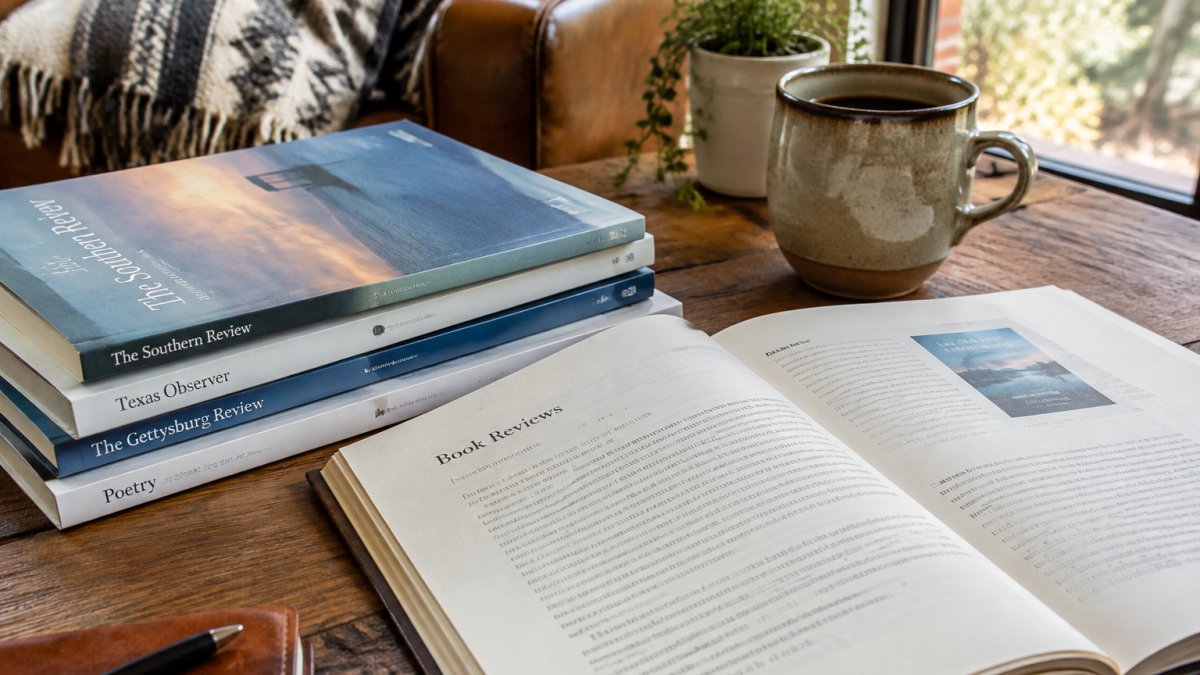
Review of Texas Books is another publication readers may wish to explore for retrospective regional judgment.
General readers may find the Texas Monthly culture section useful for discovery, and Publishers Weekly is another publication readers sometimes consult for reviews.
University-affiliated literary journals are another place readers may find longer essays on a single title.
| Source | Format | Cost | Cadence | Best For |
|---|---|---|---|---|
| Texas Books in Review | Academic reviews | Free | Scheduled issues | Deep critical analysis |
| Review of Texas Books | Annual publication | Free | Annual | Retrospective regional judgment |
| Texas Monthly Culture | Magazine reviews | Free / subscription | Seasonal | Popular discovery |
| Publishers Weekly | Industry reviews | Free tier | Weekly | Plot and market context |
| University literary journals | Long-form essays | Free / subscription | Varies | Sustained argument on one title |
Best for: Readers who want scholarly depth and a searchable archive. Skip if: You need same-week discovery of new releases, in that case, start with the seasonal magazine lists and work backward to the journals.
Watch out: A review that never names a specific scene, chapter, or structural choice may be summarizing a press release. Cross-check any glowing quote against the outlet's archive before you let it shape a purchase.
How Texas Literary Magazines and Journals Shape Critical Reception
Texas literary magazines and journals are one part of the ecosystem that shapes which books get noticed.
The Texas Book Consortium supports this ecosystem by coordinating distribution for independent and university presses, which means a debut novel can reach readers far beyond its home town. Without that infrastructure, many regional books would never earn a critical reception at all.
Literary journals are sometimes treated as a closed academic club, but readers can trace a novel's early coverage to understand why it was praised.
Exploring Literary Fiction Set in Texas: Themes, Settings, and Standouts
Literary fiction set in Texas tends to circle a handful of enduring themes: family, memory, courage, and the slow passage of time. Coastal settings bring their own texture, from tidal marshes to working harbors, and the best novels make those places feel like characters. But theme alone does not help you choose a book. What helps is grouping titles by the thread you are actually in the mood for, then reading across regions to see how different authors handle the same material.
When evaluating a Texas-set novel, readers can look for regional authenticity first. Does the author know how the light hits the bay at dusk? Does the dialogue carry a regional voice without tipping into caricature? Readers who want a practical method for this search can follow our guide on how to find authentic Texas coastal fiction, which breaks the process into concrete steps.
The standouts share one trait: their settings are load-bearing. Remove the place and the story collapses. That is the difference between contemporary fiction that happens to be set in Texas and genuine regional literature. To make that test concrete, here are three thematic reading guides you can build or borrow from, each groups titles by interest rather than geography, which is the approach most archives and single-book reviews never take.
The Texas Borderlands. Novels in this thread treat the Rio Grande corridor as a lived place rather than a backdrop, and they reward readers who want fiction about language, migration, and divided loyalty. Pair a contemporary border novel with an older historical title to see how the same landscape has been imagined across decades. The test question: does the author render both sides of the river with equal specificity, or does one side read as scenery?
Urban Texas Life. Houston, Dallas, Austin, and San Antonio each produce fiction about ambition, sprawl, and the friction between old neighborhoods and new money. This thread is where you find the strongest character-driven work, because city novels live or die on voice. Read two novels set in different cities back to back and note how each handles traffic, weather, and the ordinary logistics of daily life, that is where authenticity shows.
Texas Gothic. This is the thread most under-served by mainstream coverage: family secrets, isolated properties, heat, and a persistent sense of the past refusing to stay buried. It overlaps with literary fiction more than with horror, and it is where regional folklore and storytelling traditions feed directly into contemporary novels. If you liked a book for its atmosphere rather than its plot, this is the thread to follow next.
Building a curated 'best of the decade' list is one useful way for a reader to organize their own choices. The method is simple: pick ten novels published in the last ten years, sort them into the three threads above, and write one sentence per title naming the structural choice that made it work. That list becomes your own critical filter, and it will outperform any algorithm because you wrote the criteria.
Watch out: A thematic label can flatten a book. If a novel is filed under 'Texas Gothic' but its real achievement is comic dialogue, the label will send you in with the wrong expectations. Read the first chapter before you accept any category, including ours.
What to Look for in a Review: Plot Development, Narrative Voice, and Regional Authenticity
A useful review answers three questions. First, does the plot development hold together, or does the story rely on coincidence to move forward? Second, does the narrative voice feel controlled and distinct? Third, is the regional authenticity earned or borrowed?
Narrative pacing is where many reviews stay vague. Look for a critic who names specific structural choices, such as a slow first act or a compressed final chapter, rather than offering a general impression. Character arc matters too, and a strong critique will tell you whether the protagonist actually changes or simply observes.
Regional authenticity is the hardest to fake. A reviewer who lives near the setting will notice when a book gets the geography wrong, and that single detail often signals how carefully the rest was researched. If you are still learning to tell literary fiction apart from genre fiction, our comparison of literary fiction versus thriller novels clarifies the key differences in pacing, prose style, and resolution.
Watch out: Reviews that spend more words on the author's biography than on the book itself may signal a puff piece. Skip them and find a critique with a real argument.
Independent Bookstores and Thematic Reading Guides for Texas Fiction
Independent bookstores can be a useful discovery channel for regional literature. Staff at a coastal or small-town shop may read locally, and their shelf notes can be a helpful complement to algorithm-driven recommendations. Ask for their staff picks by sub-genre, whether historical fiction, coastal contemporary, or short story collections.
Thematic reading guides solve a different problem. Instead of one book, they group titles around a shared thread, such as novels about family legacies or stories built around a single season on the water. Building your own guide is straightforward:
- Pick one theme, such as memory or friendship
- Choose three novels set in different parts of the state
- Add one short story collection for range
- Include one historical fiction title for context
- Note each book's narrative voice in a sentence
Finding Your Next Read: How to Use Reviews to Choose a Texas Novel
Using reviews well can come down to matching the critic to your taste. Start with sources that share your priorities, then consider reading more than one review of the same book before you commit. One critic may value prose style above all else, while another weighs plot development more heavily, and knowing which lens you trust saves hours.
A practical approach we recommend:
- Read the review's opening verdict first
- Check whether the critic names specific scenes or stays abstract
- Look for a stated limitation, since honest reviews always include one
- Cross-check the publication history through a journal archive
- Confirm the book's length and format suit your reading habits
When you are ready to act on what you have read, you can go straight to our Gulf Coast literary novel and see whether it fits the themes you have been chasing. Reviews narrow the field; the first chapter settles it.
Regional novels that stay with readers for years often do so because of their authenticity, and that is the standard John Morgan aims for. John Morgan writes literary fiction rooted in the Texas Gulf Coast, drawing on four decades of life in Seabrook, Texas, to capture the sights, sounds, and spirit of Galveston Bay. Our debut novella, Stars Over Redfish Island, co-authored with Linda Ward, explores family, courage, and friendship through characters shaped by the water and the passage of time. If you want a story that treats its setting as essential rather than decorative, get started with John Morgan and find your next read today.
Frequently Asked Questions
What are some of the best fiction books set in Texas?
Readers often point to classics such as Larry McMurtry's Lonesome Dove. For a coastal focus, John Morgan's Stars Over Redfish Island offers an immersive look at Galveston Bay.
Where can I find reputable literary reviews for books by Texas authors?
Always check the reviewer's credentials and the publication's editorial standards to gauge reliability.
What defines the 'Texas literary' genre in modern fiction?
Texas literary fiction often emphasizes setting-driven narratives, regional voice, and cultural identity. It explores themes of family, land, and history through prose style that captures the cadence of local speech. While not a rigid category, works share a strong sense of place, whether the Gulf Coast, Hill Country, or East Texas. Reviews frequently highlight authenticity and narrative pacing as key markers.
Are there specific literary journals that focus on regional storytelling?
Readers interested in regional storytelling can explore a range of literary journals and presses.
